


Buyer’s guide · Ecommerce development Canada
Ecommerce Website Development Costs in Canada: Platforms, Features and Budget
Online stores are where website budgets surprise people: the same “we want to sell online” brief can cost $6,000 or $60,000, and both quotes can be honest. The difference is platform choice, catalogue complexity, Canadian tax and shipping realities, and integrations — none of which appear in a homepage mockup. This guide breaks down what ecommerce development really costs in Canada in 2026, platform by platform and feature by feature, so you can budget before you fall in love with a design.
What ecommerce development includes (beyond a website)
An online store is a marketing website plus a transactional system. Everything in our general website cost guide still applies — design approach, unique layouts, content readiness — and then commerce adds its own stack: product data modelling (sizes, colours, bundles), checkout and payment integration, tax configuration, shipping logic, order and inventory management, transactional email, and the security bar that comes with taking payments. Each is real scope; together they explain why store quotes start where brochure-site quotes end.
Platform choice: three cost profiles

The honest three-year math: Shopify is cheaper to launch and charges you monthly plus per-app plus (unless you use Shopify Payments) per-transaction — costs scale with your success. WooCommerce costs more up front, then runs on hosting and maintenance you control, with no platform cut of sales — better margins at volume, but the maintenance responsibility is yours (or your partner’s). Custom builds only make sense when the store’s requirements — unusual pricing models, deep ERP integration, B2B portals — genuinely exceed what the platforms do, which is rarer than agencies selling custom builds suggest.
Our bias, disclosed: we build and host WooCommerce because most of our clients value ownership and content+commerce together — that reasoning is laid out on our ecommerce development service page. Shopify remains the right answer for plenty of product-first stores, and we say so when it is.
2026 cost ranges by store type
| Store type | Typical build (CAD) | Timeline | What defines it |
|---|---|---|---|
| Starter store | $5,000 – $12,000 | 4–8 weeks | Up to ~50 products, standard checkout, Stripe/PayPal, basic shipping rules |
| Growing store | $12,000 – $30,000 | 8–16 weeks | Larger catalogue, product variants, carrier-rate shipping, accounting/email integrations, custom design |
| Complex / custom | $30,000+ | 3–6+ months | ERP/inventory sync, B2B pricing tiers, subscriptions, multilingual, custom checkout flows |
These assume Canadian professional rates ($75–150/hour). A store built for $2,000 exists — as a template with your logo, default checkout, and nobody having tested what happens when someone in Manitoba buys a gift card. Sometimes that is genuinely enough to validate a product; just know what you bought.
The feature-by-feature cost drivers

- Catalogue size and structure. Fifty simple products import in an afternoon. Two thousand products with size/colour variants, bundles, and inconsistent source data is a project of its own — data cleanup is the perennially underestimated line.
- Canadian payments and taxes. GST/HST/PST by province, tax-exempt categories, and proper invoices. Modern plugins handle most of it, but configuring and testing tax correctness across provinces is real work your accountant will thank you for.
- Shipping logic. Flat rates are cheap; live carrier rates (Canada Post, UPS), free-shipping thresholds, local pickup, and a returns flow each add configuration and edge cases. Shipping rules are where checkout bugs live.
- Integrations. QuickBooks/Xero sync, inventory systems, email marketing (Klaviyo/Mailchimp), and CRMs each add $500–$5,000 depending on depth. Integration count is the single best predictor of quote size.
- Advanced features. Subscriptions, memberships, B2B wholesale pricing, and bilingual stores (a legal reality for some markets) each push toward the complex tier.
Running costs: a store is not a brochure
| Item | WooCommerce (monthly) | Shopify (monthly) |
|---|---|---|
| Platform / hosting | $30 – $150 (quality hosting) | $51 – $399 (plan) |
| Apps / plugins | $20 – $100 (licences) | $50 – $300 (apps) |
| Maintenance | $100 – $250 | $0 – $150 (less needed) |
| Transaction fees | Payment processor only (~2.9%) | Processor + 0.5–2% platform fee unless Shopify Payments |
Two notes. First, store maintenance matters more than marketing-site maintenance: an update that breaks checkout costs revenue by the hour, which is why stores belong on the weekly rhythm of our maintenance checklist, with test transactions after every update pass. Second, at meaningful sales volume, percentage fees dominate everything: 1.5% of $40,000/month is $600/month — compare platforms on that math, not on the plan price.
Choosing a development partner
Everything in our guide to choosing a design firm applies, plus four store-specific questions:
- “Walk me through a store you built that is still running two years later.” Longevity, not launch screenshots.
- “Who configures taxes and shipping, and how do you test them?” Vague answers here predict checkout bugs.
- “What happens when WooCommerce/Shopify ships a breaking update?” You are hiring the maintenance relationship as much as the build.
- “What does my monthly all-in cost look like at 10 sales a day?” Forces the fee math into the open.
The budget-saving move: launch in phases
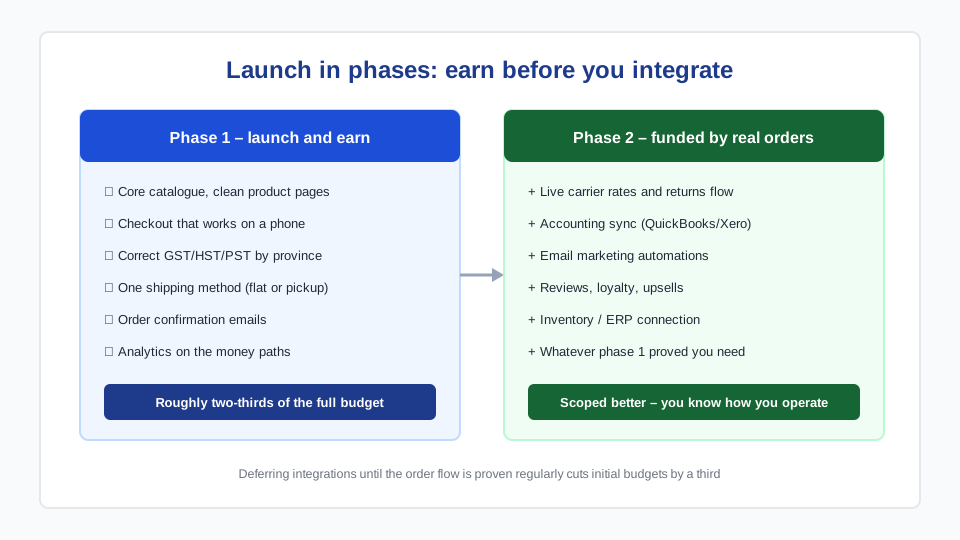
The cheapest store is the one that starts earning before it is finished. Phase one: core catalogue, clean checkout, correct taxes, one shipping method, order emails. Phase two, funded by real orders: carrier rates, accounting sync, email marketing automation, loyalty. Deferring integrations until the order flow is proven regularly cuts initial budgets by a third — and phase two gets scoped better because you finally know how you actually operate.
Frequently asked questions
WooCommerce or Shopify — which is cheaper over three years?
At low volume, Shopify usually wins: lower build cost and bundled hosting outweigh its fees. As volume grows, WooCommerce takes over: no platform percentage on sales and flat hosting/maintenance costs mean the gap widens with every order. Model your own numbers at realistic sales volume — the platform fee percentage is the term that dominates the three-year total.
What is the cheapest way to start selling online?
Validate first, build later: a Shopify starter plan, a WooCommerce store on a quality template, or even Instagram/marketplace sales prove demand for under $1,000. Once orders are real, invest in the proper build with the confidence of actual data. The expensive mistake is a $25,000 store for a product that has never sold a unit.
How much do ecommerce integrations cost?
Rules of thumb per integration: accounting sync (QuickBooks/Xero) $500–$2,000; email marketing with automations $500–$1,500; live carrier shipping rates $300–$1,000; inventory/ERP sync $2,000–$10,000+ depending on the system. Integration count and depth is the main reason two quotes for “the same store” differ by multiples.
What are the monthly costs of running an online store?
A maintained small-business store realistically runs $150–$500+/month: platform or hosting, app/plugin licences, maintenance with test transactions, and payment processing around 2.9% + 30¢ per order (plus Shopify’s platform fee if applicable). Stores cost more to run than marketing sites because more can break and breakage costs revenue immediately.
How long does an ecommerce website take to build?
A starter store ships in 4–8 weeks; a growing store with integrations in 8–16 weeks; custom builds run 3–6+ months. The schedule’s biggest variable is rarely development — it is product data readiness: photos, descriptions, prices, and variant logic arriving complete and consistent. Start the catalogue spreadsheet before you hire anyone.
Do I need a custom ecommerce build?
Probably not. WooCommerce and Shopify cover the overwhelming majority of retail models out of the box or with mature extensions. Custom is justified when the store is the business and off-the-shelf demonstrably fails: unusual pricing engines, deep ERP dependency, complex B2B contract terms. If an agency proposes custom without first showing why the platforms fail your requirements, get a second opinion.